What co-classification means
Co-classification is not a feature. It is a different approach to who makes the decision.
In autonomous classification, the AI navigates the HS tree end-to-end and presents a result. The human can accept or reject it, but the reasoning is opaque — and the record of any intermediate considerations does not exist.
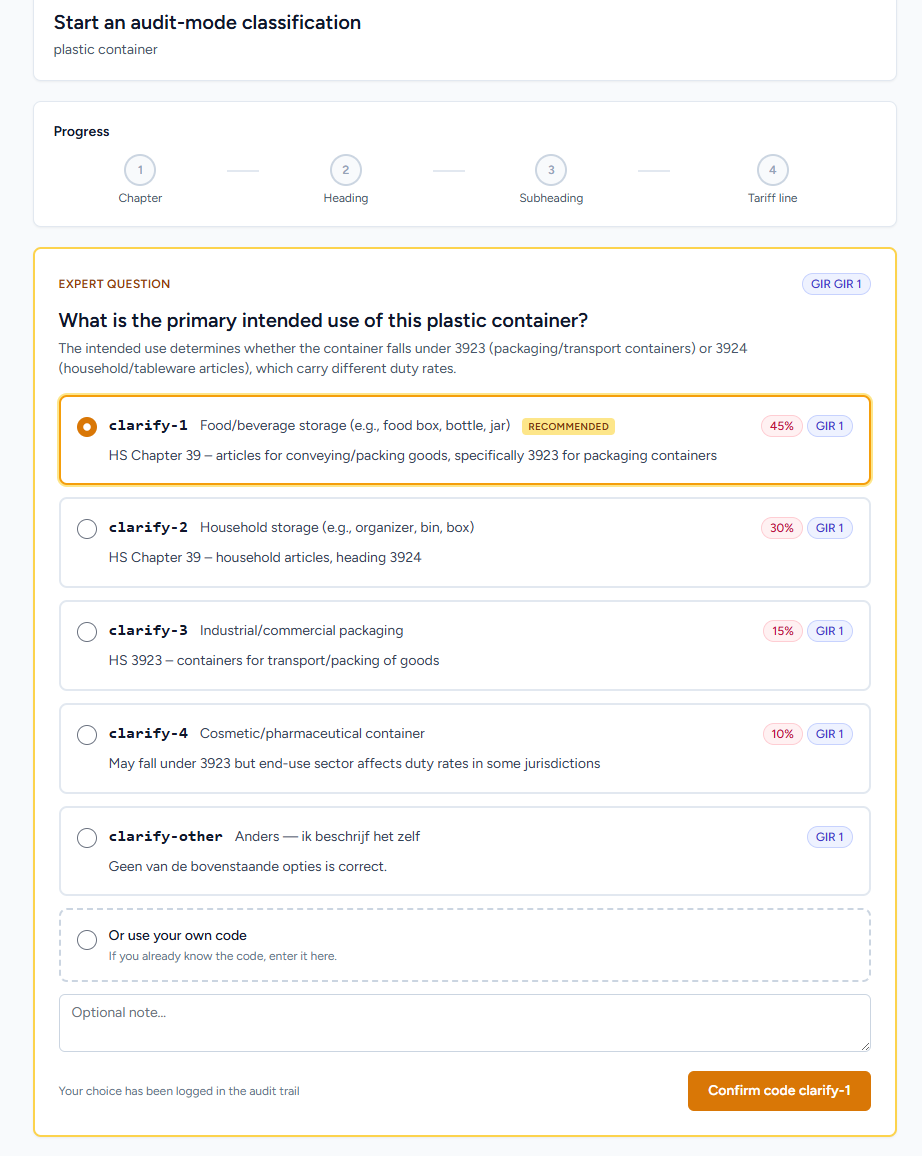
In co-classification, the AI and a human share the decision at every branching point. The AI does the analytical work: it reads the product image, interprets the description, and identifies the most relevant options at each node in the HS tree — chapter, heading, subheading, and tariff line. The human sees those options, reads the reasoning behind each, and confirms a choice. That confirmation is logged.
This distinction matters for three reasons.
Accuracy at the margin.
Autonomous AI performs well on products that map cleanly to a single chapter. Where two headings both have a plausible claim — a product that is simultaneously textile and plastic, or a device that sits between chapters 84 and 85 — the AI must pick one. In co-classification, that is exactly the moment where human knowledge enters. The person classifying the product knows whether it is sold as a textile article or a technical component, knows the chapter note distinctions, and can make the call with full context. The AI narrows it down. You confirm the call.
The always-confirm philosophy.
Import8 Audit-mode is built on an architectural principle called always-confirm (documented as ADR-003 in the codebase). Even when the AI has high confidence in its recommendation at a given node, it still presents alternatives and requires human confirmation before moving to the next level. This is not a user experience choice — it is the mechanism that gives the audit trail its legal grounding. A classification is only defendable if a human made every decision consciously. Bypassing confirmation for high-confidence nodes would undermine that.
The output is different.
Autonomous classification produces a code. Co-classification produces a code plus a documented decision path — what was considered at every node, what was rejected, what rule was applied, who confirmed it, and when. That second output is what turns a classification into evidence.
This is the fundamental difference between co-classification and "AI does everything and you approve at the end." End-approval is a rubber stamp. Node-by-node confirmation is a legal record.
The mechanics: what happens at every node
The walk-the-tree process in Import8 Audit-mode follows the structure of the HS nomenclature itself, working from the broadest category (chapter) to the most specific (10-digit tariff line).
Image analysis and description confirmation
The process starts before the first HS decision. Import8 reads the product image using AI vision and generates a structured product description — material, form, purpose, and any relevant physical characteristics. Before classification begins, you review and confirm that description. If it is incomplete or wrong, you correct it. This matters because the description you confirm becomes the basis for all subsequent classification decisions, and it appears in the audit PDF as the starting point of the decision chain.
Chapter selection
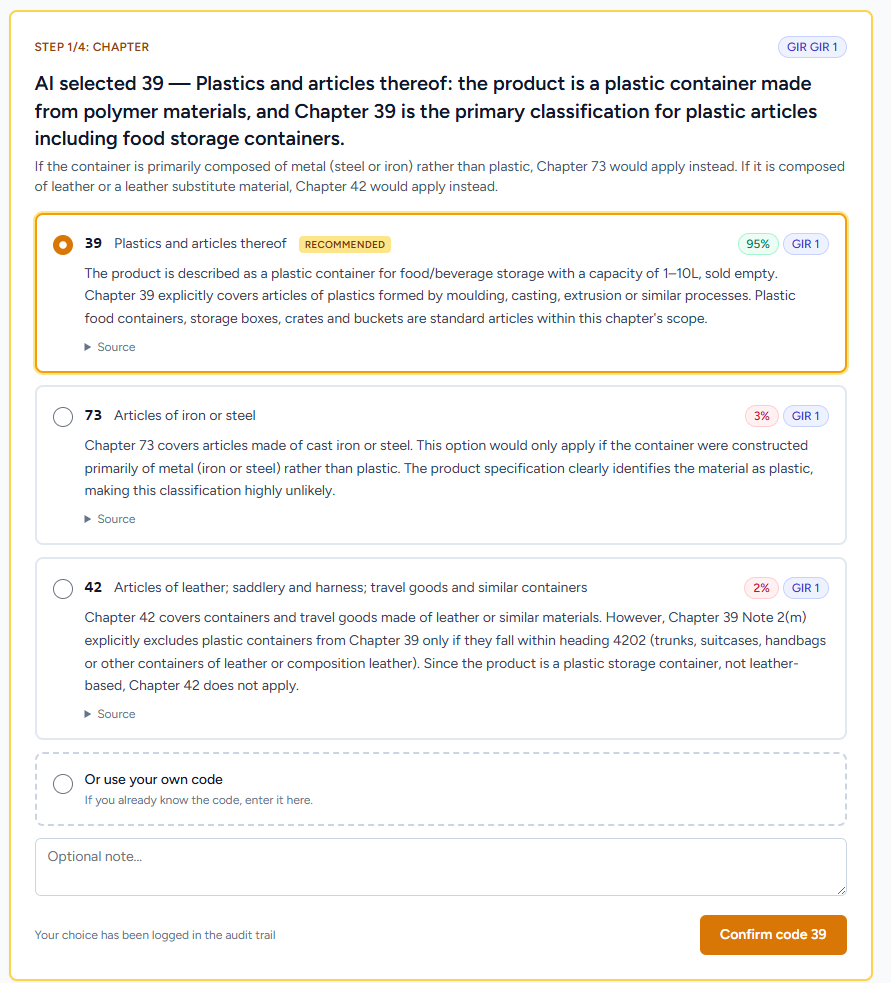
At the chapter level, the AI presents its top 2–5 alternatives. Each option shows the chapter title, the relevant GIR (General Interpretative Rules) rule that supports that chapter, the applicable chapter note citation, and a confidence indicator. The recommendation is pre-selected, but you review the alternatives before confirming. A leather handbag might see chapters 42 and 63 as alternatives — the AI explains why chapter 42 applies (articles of leather, GIR 1, chapter note exclusion of textile articles) and why 63 does not. You confirm chapter 42.
Heading and subheading
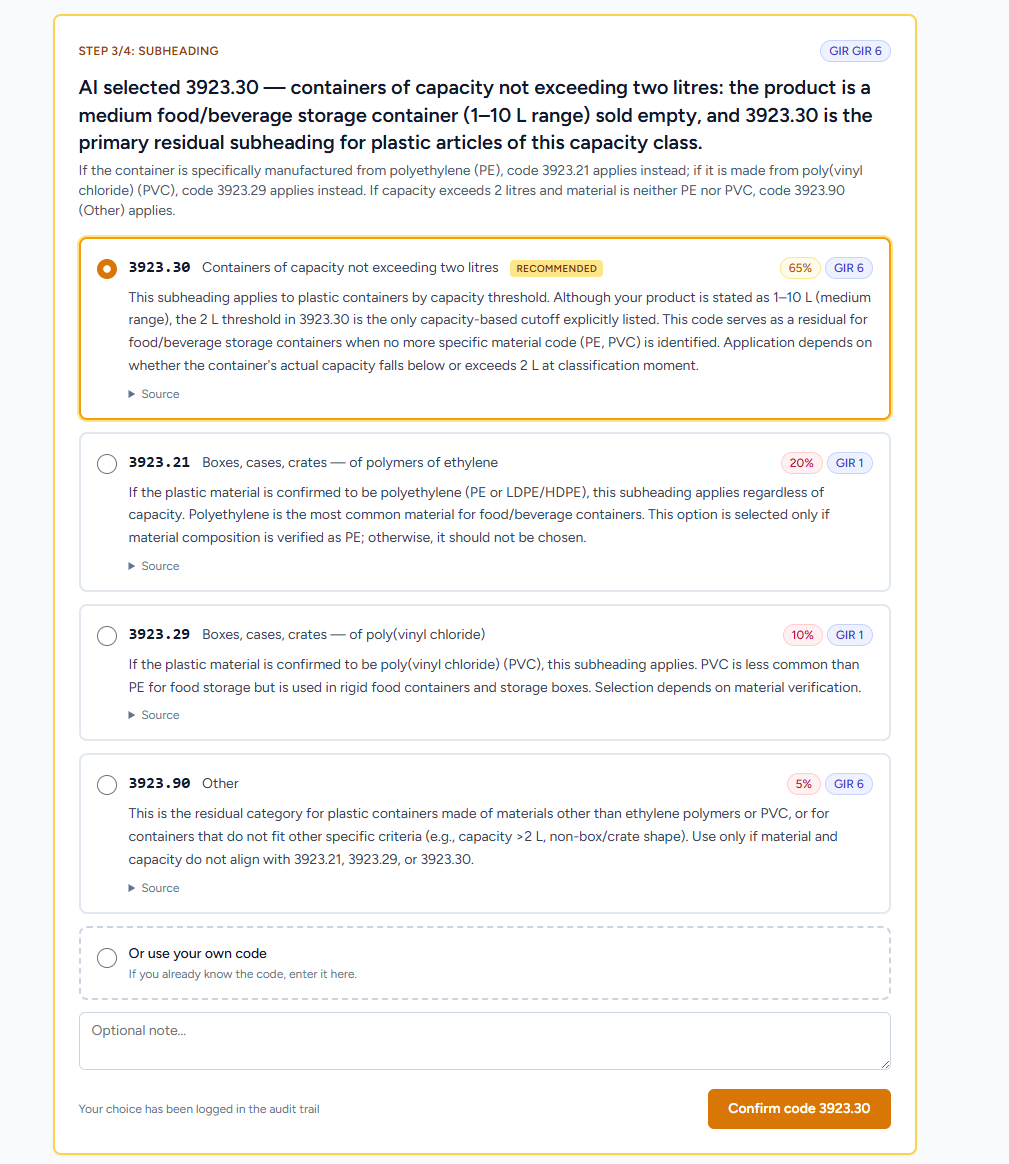
The same pattern repeats at heading and subheading level. For heading 4202 (travel goods and handbags), the alternatives might include 4205 (other articles of leather). Each card shows the heading text, the differentiating chapter note or section note, and the GIR rule. At subheading level, the distinction between 4202.21 (outer surface of leather) and 4202.22 (outer surface of sheeting of plastics or textile) is material-specific and frequently contested. Co-classification surfaces that distinction explicitly and logs which option was selected and on what basis.
Tariff line
The final step resolves the 8-digit subheading to a 10-digit tariff line (the TARIC level). This is the level at which duty rates and trade measures apply, and it is where misclassification has direct financial consequences. Import8 shows the available tariff lines under the confirmed subheading, with any applicable trade measure flags visible.
What gets logged at each node
At every step, Import8 records:
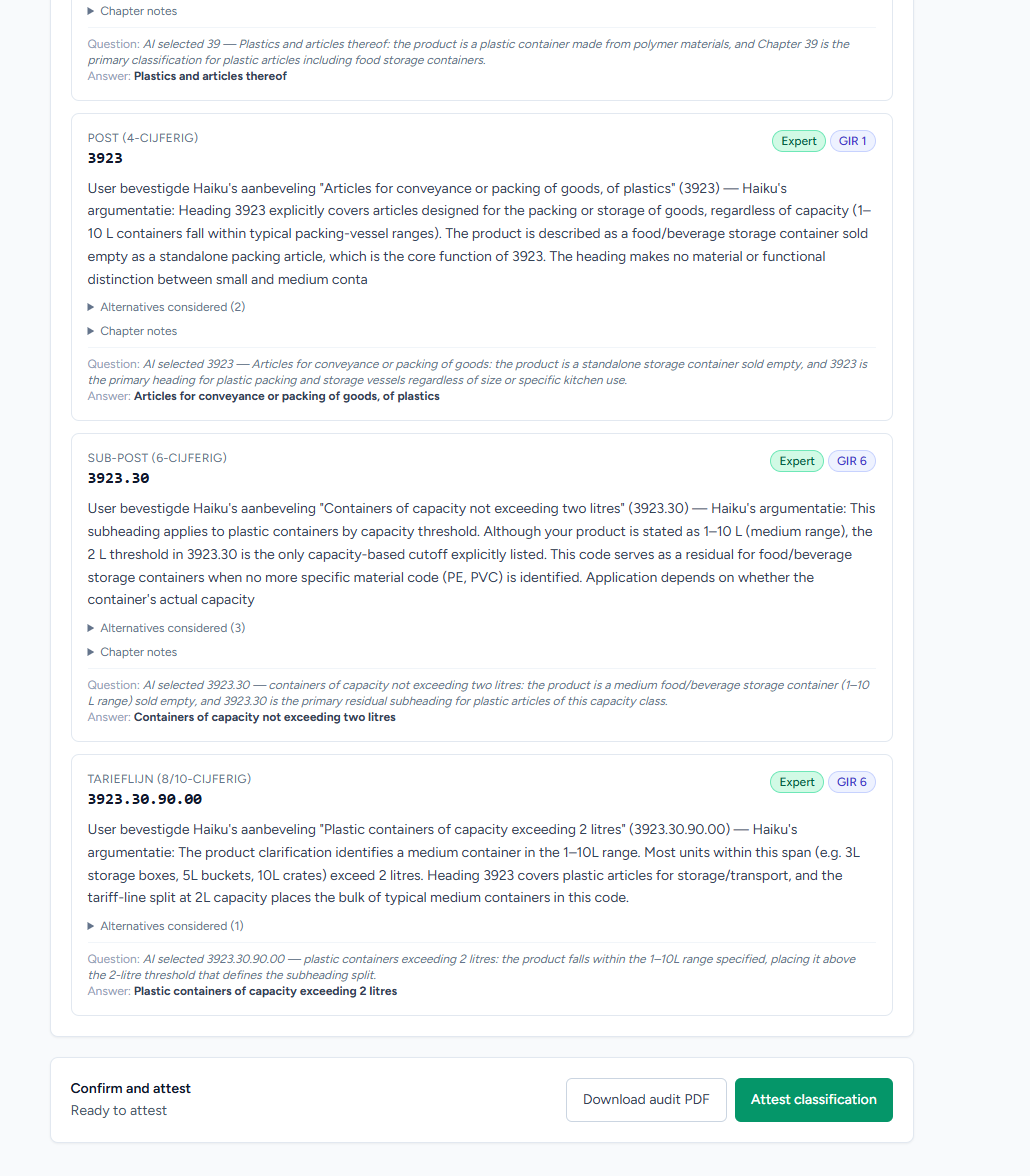
- The confirmed code and the reasoning for selecting it
- The alternatives that were presented and rejected, with their reasoning (alternatives_considered)
- Which GIR rule governed the decision
- The relevant chapter note or section note that was cited
- The timestamp of confirmation
This alternatives_considered log is the most important element for audit defense. It demonstrates that the classification was not a default — it was a choice made in awareness of the alternatives.
See it in action
A real Audit-mode walkthrough — classifying a plastic storage container from the first clarifying question through to the confirmed tariff line, ready to attest.
The audit-trail output
At the end of a co-classification session, Import8 generates an audit PDF. This is not a summary — it is a structured record of the full decision process.
What the audit PDF contains
The document opens with the final 10-digit tariff code, the confirmed product description, and the product image. It then reproduces the decision path node by node: chapter → heading → subheading → tariff line, with each confirmation documented. For every node, the PDF shows the selected option, the alternatives that were considered, the GIR rule applied, and the relevant nomenclature citation.
Below the decision path, the PDF records the version information that makes the classification reproducible: the AI model version used for the analysis, the prompt version, and the TARIC nomenclature version in effect at the time of classification. It includes the timestamp of the session, the device and browser information of the user who attested the classification, and the IP address at attestation.
Reproducibility over 1–3 years
Post-clearance audits under article 48 UCC can reach back up to three years (in cases of non-fraudulent underpayment) or further. A classification made today may be scrutinised in 2028. The version-pinning in the Import8 audit PDF means that in 2028, the classification can be replicated through the same pipeline with the same model version, same prompt, and same TARIC revision — producing the same output. This is the reproducibility claim: not that the AI was right, but that the process can be verified.
Relationship to Binding Tariff Information
The audit trail does not replace a BTI (Binding Tariff Information). A BTI, issued under articles 33–37 UCC by a customs authority, provides legal certainty — if you have a valid BTI, the classification it specifies is binding on the customs authority for three years. The Import8 audit PDF provides no such certainty.
What it provides is due-diligence documentation. Under article 15 UCC (accuracy obligations), a declarant who can demonstrate that they applied a structured, documented classification process — consulting the nomenclature, applying GIR rules, considering alternatives, and confirming each step with a qualified person — is in a materially better position than one who cannot. Under article 119 UCC (relief from customs debt in good-faith circumstances), documented due diligence is a relevant factor. The audit PDF is evidence of that process.
Try Import8 Audit-mode
When co-classification beats autonomous
Co-classification is not always the right choice. Express-mode (fully autonomous, no confirmation steps) is the right tool for situations where speed matters more than an audit trail — high-volume e-commerce orders, repeat products where the code has already been established, or quick sanity checks before placing a purchase order.
Use the following decision framework:
| Situation | Recommended mode |
|---|---|
| E-commerce, low declared value per shipment | Express |
| Sanity-check before ordering from a supplier | Express |
| Repeat product, code already established | Express |
| High-value shipment (significant duty exposure) | Audit |
| Regulated category: textiles, electronics, toys, food | Audit |
| AEO status or compliance requirements from parent company | Audit |
| Customs broker filing declarations on behalf of a client | Audit |
| Organisation that has received a post-clearance correction notice | Audit |
| Two codes with large duty differentials, genuine doubt | Audit |
The strongest use case for co-classification is the combination of high value and regulatory sensitivity — a large textile shipment, an electronics component with dual-use potential, or a product in a category that is currently under anti-dumping scrutiny.
A hybrid approach is valid. Import8 supports both modes within a single organisation. Use Express for your regular bulk volume; switch to Audit for the shipments where classification needs to hold up under scrutiny. The Express-mode benchmark — 91% at 6-digit, 97% at 8-digit, 93% at 10-digit, measured on 283 independent EBTI products across 54 chapters — is the floor. Audit-mode adds human confirmation at the points where autonomous AI would have to make a judgement call.
For a full walkthrough of Audit-mode, including the step-by-step UI and PDF output, see Audit-mode: full walkthrough.
To understand how Express-mode accuracy was measured, see How Import8 Express-mode benchmarks.
The problem with autonomous AI classification
Autonomous classification tools have a simple promise: upload a photo or description, get a 10-digit HS code. For high-volume, low-value shipments that works well. For everything else, that promise has a structural flaw.
When a customs auditor asks why you classified a shipment under heading 4202 instead of 6307, "the AI said so" is not a defensible answer. It is not even an answer. It is an admission that no human made a conscious, documented decision.
Under the Union Customs Code, declarants bear responsibility for the accuracy of their declarations. Article 15 requires that any information submitted to customs authorities is accurate, complete, and authentic. Article 77 ties the customs debt to the customs declaration itself. Where a misclassification leads to underpaid duties, article 119 allows a debtor to claim relief — but only if they can demonstrate good faith and that they exercised due diligence. That due-diligence requirement is where autonomous AI classification has no answer.
The black-box problem is not about accuracy. It is about reconstructability.
A system that achieves 95% accuracy in testing still gets things wrong. When it does, the question is not only whether the code was right or wrong — it is whether the person who filed the declaration made a reasoned, documented choice at the time, based on the information available. Autonomous AI cannot provide that record, because no human was involved in making the decision.
The consequences of misclassification vary depending on the product category, declared value, and duty rates involved. Textile products, electronics, and goods subject to trade measures carry additional exposure because duty differentials between adjacent codes can be significant. The risk is not theoretical: post-clearance audits under article 48 UCC are a standard enforcement tool at EU customs authorities. An auditor who finds a pattern of misclassified shipments will ask for your classification methodology. "We used an AI tool" without supporting documentation puts you in a weak position.
Co-classification is the answer to that structural problem. For a catalogue of what goes wrong without a structured process, see our HS code mistakes guide.
