Why China Dominates EU Imports
China is the European Union's largest source of imported goods. In 2024, EU imports from China totalled approximately €460 billion — accounting for over 20% of all extra-EU imports. From electronics and machinery to textiles and consumer goods, Chinese manufacturers supply products across virtually every industry.
The reasons are straightforward: massive manufacturing capacity, competitive pricing, a mature export infrastructure, and an increasingly sophisticated product range. For European businesses, buying from China often means significantly lower unit costs — but the savings only materialize if you navigate customs, compliance, and logistics correctly.
This guide covers the entire process from sourcing to customs clearance, with a focus on what EU importers specifically need to know.
EU imports from China (2024)
Share of all extra-EU imports
No EU-China free trade agreement — full MFN duties apply
The Import Process: Step by Step
Importing from China to the EU involves a chain of decisions, each affecting your cost and timeline. Here's the high-level flow:
Sourcing & supplier selection
Find a manufacturer or trading company. Verify their legitimacy, request samples, negotiate pricing and MOQ (minimum order quantity).
Product classification
Determine the correct HS/TARIC code before you order. This dictates your duty rate, any anti-dumping surcharges, and required compliance certifications.
Cost calculation
Factor in product cost, shipping, insurance, import duties, anti-dumping duties (if applicable), and VAT. The "landed cost" is what matters, not the FOB price.
Quality control & production
Arrange pre-shipment inspection. Verify product specs, packaging, labelling, and compliance markings (CE, REACH, etc.) before goods leave China.
Shipping & logistics
Choose sea freight (25-40 days), air freight (5-10 days), or rail (18-22 days). Arrange a freight forwarder and insure the shipment.
Customs clearance
Submit the customs declaration with all documentation. Pay import duties and VAT. Clear the goods for free circulation in the EU.
Last-mile delivery
Once cleared, goods move to your warehouse or directly to your customers. In the EU, once cleared in one member state, goods circulate freely.
Key insight: Steps 2 and 3 should happen before you commit to a purchase. Knowing your HS code and landed cost upfront prevents surprises at the border. Our free Duty Calculator helps you estimate costs before ordering.
Finding Reliable Suppliers
The supplier you choose determines everything: product quality, reliability, lead times, and your ability to resolve problems. Here's how the landscape works:
Manufacturers (direct)
Lower unit price, but higher MOQs (often 500+ units). Best for established products you plan to reorder. You deal directly with the factory, which gives more control over specs and customization.
Trading companies
Higher unit price (10-30% markup), but lower MOQs and they handle the factory relationship. They often speak better English and can source from multiple factories. Good for first-time importers or diverse product ranges.
Sourcing agents
A sourcing agent acts as your representative in China. They find factories, negotiate prices, arrange quality inspections, and manage logistics. Particularly valuable if you import multiple product categories or lack experience with Chinese manufacturing.
Where to find suppliers
The main platforms are Alibaba (largest, broadest range), Made-in-China (more factory-direct), and Global Sources (verified suppliers, better for electronics). For higher-value sourcing, the Canton Fair (held biannually in Guangzhou) remains the most important in-person trade event.
Supplier verification checklist
HS Codes & Customs Classification
Every product entering the EU must be classified with a TARIC code — a 10-digit number that determines your duty rate, applicable trade measures, and compliance requirements. For imports from China specifically, classification is critical because many Chinese product categories carry additional measures: anti-dumping duties, safeguard duties, or surveillance quotas.
The classification process starts with the international HS code (6 digits, universal), extends to the EU's Combined Nomenclature (8 digits), and finally the TARIC code (10 digits) which captures all EU-specific measures.
Getting this wrong has real consequences. A misclassification can mean:
If your rate is too low
Customs can retroactively charge the difference for up to 3 years of past imports. Penalties on top. Potential fraud investigation.
If your rate is too high
You overpay on every shipment. On a €100K annual import, a 3% overcharge costs you €3,000/year — money you don't get back unless you file a claim.
Why classification matters more for China imports
China has no free trade agreement with the EU, so full MFN (Most Favoured Nation) duty rates apply. On top of that, over 100 product categories from China carry anti-dumping duties — additional tariffs ranging from 7% to over 80%. These are tied to specific TARIC codes and origin country combinations. One digit wrong in your code could mean the difference between 0% anti-dumping and 48%.
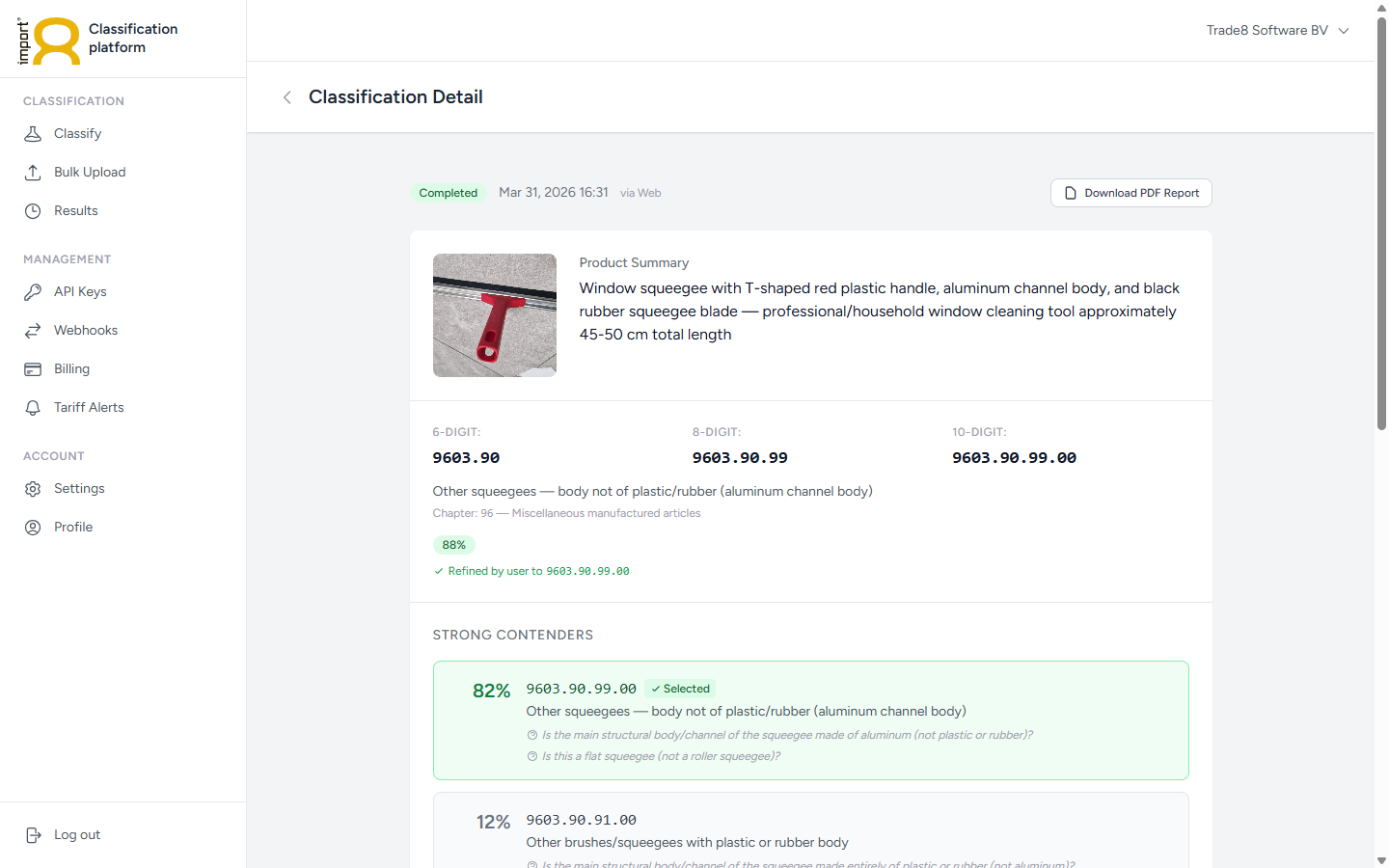
Not sure about your HS code?
Upload a product photo or description and get a classified TARIC code in seconds. Free to try, no credit card needed.
Import Duties, VAT & Anti-Dumping
When importing from China to the EU, you pay three potential layers of tax:
Standard import duty (MFN rate)
The base tariff rate, determined by your TARIC code. For Chinese goods, MFN rates apply (typically 0-17% for manufactured goods). This is calculated on the customs value (CIF: product cost + insurance + freight to EU border). See our detailed guide on how EU import duties are calculated.
Example: €50,000 CIF × 6.5% = €3,250
Anti-dumping / countervailing duties
Additional tariffs on products the EU has determined are being sold below fair market value ("dumped"). These are on top of the standard duty and can be substantial. Examples from China:
Always check the EU's trade defence database before importing. Anti-dumping duties change regularly and can appear or disappear with new EU investigations.
Import VAT
VAT is charged on the customs value plus all duties. The rate depends on the EU member state of import (21% in the Netherlands, 19% in Germany, 20% in France, etc.). Import VAT is typically recoverable through your regular VAT return — it's a cash flow cost, not a permanent expense.
Example: (€50,000 + €3,250) × 21% = €11,182.50
Landed cost example: €50,000 shipment from China
Estimate your own costs with our free Duty Calculator.
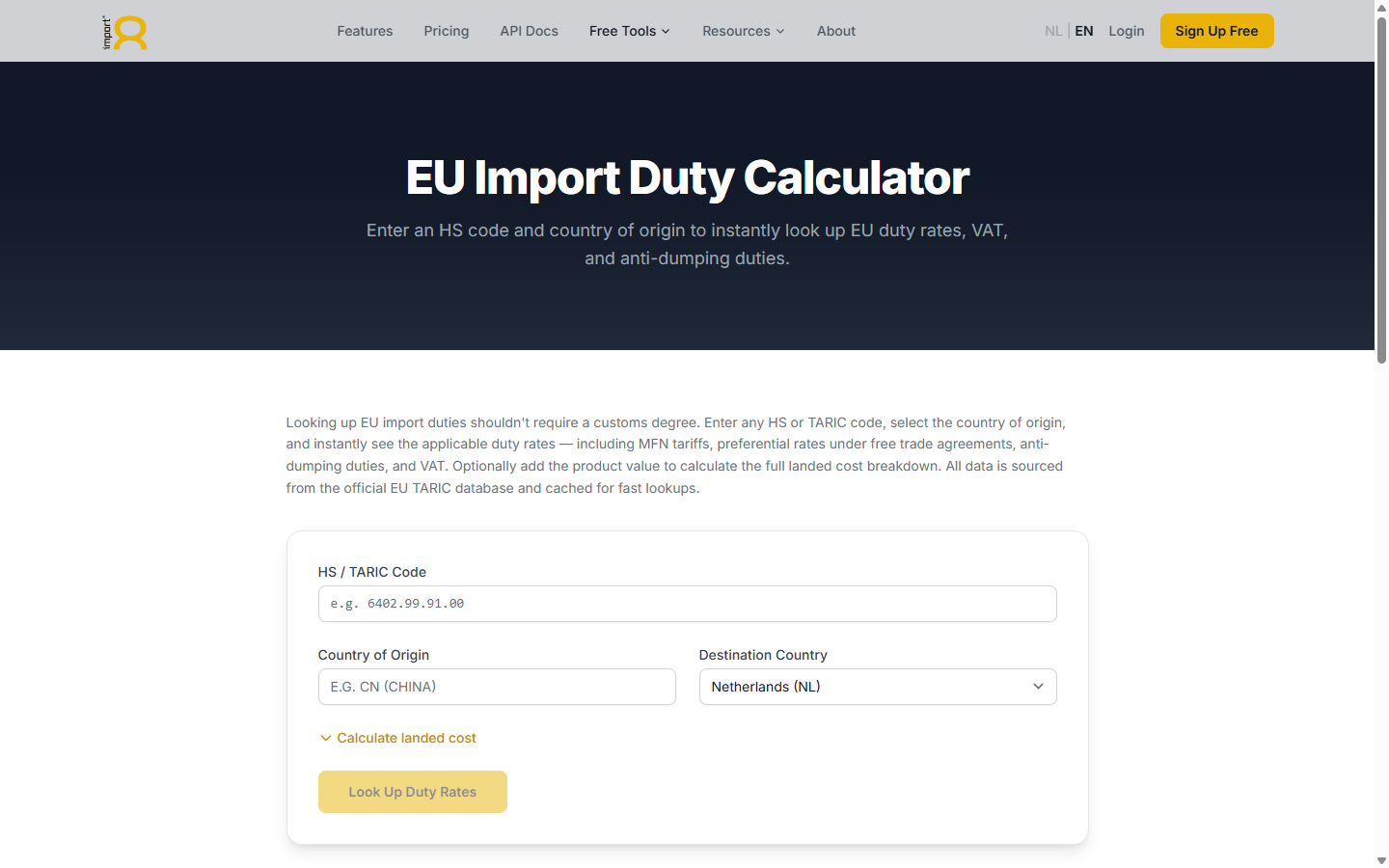
Required Documentation
Missing or incorrect documents are one of the most common causes of customs delays. For every shipment from China to the EU, you need these core documents:
Commercial Invoice
Issued by the seller. Must include: buyer/seller details, product descriptions, quantities, unit prices, total value, currency, Incoterms, and country of origin. This is the basis for customs valuation.
Packing List
Itemized list of all goods in the shipment: what's in each box/pallet, weights, dimensions. Customs uses this to verify the commercial invoice and to select goods for inspection.
Bill of Lading (B/L) or Airway Bill (AWB)
The transport document. A B/L for sea freight, AWB for air. This is your proof of shipment and, for ocean freight, also a document of title (whoever holds the original B/L can claim the goods).
Certificate of Origin (if needed)
Not always required for China-EU trade (since there's no preferential agreement), but customs may request it for anti-dumping verification or to confirm MFN eligibility.
CE Declaration of Conformity
Required for products that fall under EU CE marking directives (electronics, toys, machinery, medical devices, PPE, etc.). This is your responsibility as the importer, not the Chinese manufacturer's.
Customs Declaration (SAD / Import Declaration)
The formal declaration to customs authorities. Usually filed electronically by your customs broker. Requires the TARIC code, customs value, origin, and all supporting documents.
Tip: Ask your Chinese supplier to provide the HS code on the commercial invoice. But always verify it yourself — Chinese export codes often differ from EU import codes, and using the supplier's code without checking is a common source of misclassification.
Which documents does your product actually need?
Enter your HS code and see in seconds which EU regulations (CBAM, GPSR, REACH, anti-dumping) apply to your product — and the documents you'll need. Free, no signup.
EU Compliance & Product Safety
The EU has some of the strictest product safety and compliance requirements in the world. As the importer, you are legally responsible for ensuring products meet all applicable regulations — not the Chinese manufacturer. If a non-compliant product is found on the EU market, customs and market surveillance authorities come to you.
CE Marking
Mandatory for 25+ product categories including electronics, toys, machinery, medical devices, construction products, and PPE. CE marking means the product meets EU safety, health, and environmental requirements. You need a technical file, a Declaration of Conformity, and for some categories third-party testing.
REACH Regulation
Restricts or bans certain chemicals in products sold in the EU. Applies to virtually everything: textiles, electronics, toys, furniture, plastics. Your Chinese supplier should provide a REACH compliance declaration, but you must verify it. Common issues: lead in paint, phthalates in plastics, PFAS in textiles.
RoHS Directive
Restricts hazardous substances (lead, mercury, cadmium, etc.) in electrical and electronic equipment. If you import electronics from China, RoHS compliance is non-negotiable.
GPSR (General Product Safety Regulation)
The new EU product safety regulation (effective December 2024) requires an EU-based economic operator for many consumer products — depending on your product and whether a responsible party is already established in the EU. If this applies to you, you must be reachable, keep technical documentation, and cooperate with market surveillance authorities. Check per product whether the requirement applies to you.
EUDR (Deforestation Regulation)
If you import wood, palm oil, soy, rubber, cocoa, coffee, or cattle-derived products: from December 2025, you must prove your supply chain is deforestation-free. Applies regardless of origin country.
Warning: Non-compliance can result in product seizure at the border, forced recalls, fines, and personal liability. Budget for compliance testing and certification as part of your import costs — it's not optional.
Shipping & Logistics
Your choice of shipping method directly impacts cost, lead time, and risk. Here's how the three main options compare for China-to-EU routes:
| Sea Freight | Air Freight | Rail (China-EU) | |
|---|---|---|---|
| Transit time | 25–40 days | 5–10 days | 18–22 days |
| Cost (approx.) | €1,500–4,000/container | €3–8/kg | Between sea & air |
| Best for | Large, heavy, non-urgent | Small, high-value, urgent | Mid-size, time-sensitive |
| EU entry points | Rotterdam, Hamburg, Piraeus | Schiphol, Frankfurt, Liege | Duisburg, Hamburg, Tilburg |
Incoterms: who pays for what?
Incoterms define which costs and risks are yours versus the seller's. The three most common for China-EU trade:
7 Costly Mistakes to Avoid
These are the errors we see most often. Each one has cost real importers real money.
1. Using the supplier's HS code without verifying
Chinese export codes and EU import codes are different systems. A code that's correct for Chinese customs may be wrong for EU customs. Always verify with the EU's TARIC database or an AI classification tool. This is one of the most common HS code mistakes importers make.
2. Ignoring anti-dumping duties
You thought you'd pay 6% duty, but there's a 48% anti-dumping surcharge on your product from China. This turns a profitable import into a loss-making one. Check before you order.
3. Undervaluing goods on the invoice
Some suppliers offer to declare a lower value to reduce duties. This is customs fraud. EU customs uses data analytics to flag under-declared shipments, and penalties include backdated duties plus fines.
4. Skipping compliance testing
A CE mark printed on the product doesn't mean it's actually compliant. Some Chinese manufacturers add CE markings without testing. You need documentation: test reports, Declaration of Conformity, technical file. If market surveillance asks, "I trusted my supplier" is not a valid answer.
5. No pre-shipment inspection
The sample looked great. The bulk order doesn't match. If you didn't inspect before shipping, you now have a container of subpar goods in Rotterdam with limited options. Budget €200-300 for a third-party inspection — it's the cheapest insurance in the supply chain.
6. Paying 100% upfront
Standard payment terms are 30/70 (30% deposit, 70% after quality inspection and before shipping). Paying everything upfront removes your leverage. If there's a quality issue, getting money back from China is nearly impossible.
7. No landed cost calculation before ordering
FOB price is not your cost. Add shipping, insurance, duties (check for anti-dumping), VAT, customs broker fees, inland transport, and warehousing. Many first-time importers discover at the border that their margins have evaporated.
Frequently Asked Questions
In most cases, no special import license is required. You need a registered business with an EORI number (Economic Operators Registration and Identification) — this is free and can be obtained from your national customs authority. Some product categories require additional permits: food and agricultural products (health certificates), chemicals (REACH registration), pharmaceuticals, firearms, and certain dual-use goods.
With correct documentation, customs clearance in the EU typically takes 1-3 business days. If your shipment is selected for physical inspection, add 2-5 days. Common delays: missing or incorrect documents, HS code queries, REACH or CE compliance checks, and anti-dumping verification. Having all paperwork complete and correct before the goods arrive is the best way to avoid delays.
Yes, but commercial importing requires a registered business and EORI number. For personal imports under €150, you won't pay customs duty but you will pay import VAT (since July 2021, there's no VAT exemption for low-value goods). For commercial quantities, you need a business entity and should work with a customs broker unless you're experienced with the process.
These are Incoterms that define who pays for what. FOB (Free On Board): seller delivers to the vessel, you pay everything from there. CIF (Cost, Insurance, Freight): seller pays shipping and insurance to destination port, you pay from port onwards. DDP (Delivered Duty Paid): seller handles everything including customs clearance and duties in the EU. DDP sounds convenient but gives you zero control over customs classification — and if the seller uses the wrong HS code, you're still liable. Most experienced importers prefer FOB.
Look up your TARIC code in the EU's TARIC database with China as the origin country. Any anti-dumping or countervailing duties will appear as additional measures. You can also check our Duty Calculator which includes anti-dumping measures in its calculations. New measures are published in the Official Journal of the EU and take effect immediately.
Contact your customs broker immediately. Common reasons: missing documents (provide them), HS code dispute (prepare classification evidence), compliance check (provide CE/test certificates), or physical inspection (wait). While goods are held, you pay port storage fees (€50-200/day for containers). Act quickly — most issues are resolvable within days if you have the right documentation ready.
