What Is an HS Code?
An HS code (Harmonized System code) is a standardized numerical code used to classify traded products worldwide. It was developed and is maintained by the World Customs Organization (WCO), and it forms the backbone of every customs declaration in over 200 countries covering more than 98% of world trade. For a deeper dive into the system, see our complete guide on how HS codes work.
The first six digits of an HS code are internationally harmonized — meaning a cotton t-shirt has the same 6-digit code whether it enters the EU, the US, Japan, or Brazil. Beyond six digits, countries and trade blocs add their own extensions for more granular classification and to attach specific duty rates, trade measures, and regulatory requirements.
In the European Union, the system extends to 8 digits (the Combined Nomenclature or CN code) and then to 10 digits (the TARIC code) which captures EU-specific measures like anti-dumping duties, quotas, and surveillance.
Anatomy of an HS Code: Stainless Steel Kitchen Knife
6-digit subheadings in the Harmonized System
Distinct product codes in the EU TARIC database
Countries using the Harmonized System
Why the Right HS Code Matters
Your HS code is not just an administrative detail — it directly controls four things that affect your bottom line and your legal standing as an importer.
1. The duty rate you pay
Each TARIC code has a specific duty rate. Classify a stainless steel water bottle as "insulated vacuum flask" (9617.00, 6.7% duty) instead of "stainless steel tableware" (7323.93, 0% duty), and you overpay on every single shipment. Over a year of imports, that classification error can cost tens of thousands of euros. See our guide to EU import duties for how rates are determined.
2. Customs compliance and audits
Classification is the first thing customs authorities check during an audit. A wrong code is a red flag. If they find you have been declaring the wrong code — even unintentionally — you face back-payments for up to three years of previous imports under that code, plus interest. Deliberate misclassification is treated as customs fraud.
3. Anti-dumping and trade measures
Anti-dumping duties are tied to specific HS codes and origin countries. Chinese solar panels under heading 8541 carry anti-dumping duties that can exceed 50%. If your product falls under a code with active trade measures, the financial impact is enormous — and ignorance is not a defense.
4. Import/export licenses and restrictions
Certain codes require import licenses, phytosanitary certificates, CE marking, or other documentation. Declare the wrong code and your shipment might clear customs when it should not have — or get held up when it should sail through. Either way, it creates problems.
Real-World Example: The Tablet vs. Laptop Classification
A tablet computer with a detachable keyboard can be classified in two ways:
On a shipment worth €200,000, the difference between 0% and 3.7% is €7,400 — per shipment. Import ten containers a year, and that is €74,000 in unnecessary costs.
How to Look Up an HS Code (Traditional Methods)
Before AI-powered tools existed, finding the right HS code meant navigating complex databases and government portals. These methods still work — and understanding them helps you verify any classification result.
The EU TARIC Database
The official source for EU customs classification is the TARIC consultation tool maintained by the European Commission. You can search by keyword or browse by chapter. It shows duty rates, trade measures, anti-dumping duties, and regulatory requirements for every 10-digit code. The interface is functional but not intuitive — you need to know the HS structure to navigate efficiently.
WCO HS Nomenclature
The World Customs Organization publishes the official HS nomenclature with Explanatory Notes — detailed descriptions of what falls under each heading and subheading. These notes are the authoritative reference for classification disputes. Access requires a subscription, but they are often available through national customs authorities.
National Customs Databases
Most EU countries have their own lookup tools. The Dutch customs authority (douane.nl) provides a search interface for the Combined Nomenclature. Germany has the EZT-online. These often include national annotations and instructions that supplement the EU-wide TARIC data.
Binding Tariff Information (BTI)
If you need legal certainty about your classification, you can apply for a BTI ruling from your national customs authority. A BTI is a binding decision that tells you the exact code for your product, valid across all EU member states for three years (five years from 2024 under the updated UCC). It is free to apply, but the process takes 30 to 120 days. A BTI is worth pursuing when you import the same product repeatedly and the classification is not clear-cut.
How AI Classification Works
AI-powered classification tools take a fundamentally different approach. Instead of requiring you to navigate the HS tree manually, you describe your product — or upload a photo — and the AI identifies the most likely classification codes.
The best systems are trained on the full TARIC nomenclature, the WCO Explanatory Notes, historical BTI rulings, and millions of real customs declarations. They understand that a "stainless steel vacuum-insulated water bottle with screw cap" maps to a different code than a "stainless steel flask for laboratory use," even though both are stainless steel containers.
Describe or photograph your product
Enter a product description, paste a product URL, or upload a product image. The more detail you provide — material composition, function, intended use — the more accurate the classification.
AI matches against the full TARIC database
The system analyzes your input against thousands of product codes, applying the same classification logic a customs expert would: material composition, primary function, the General Rules of Interpretation, and the Section and Chapter Notes.
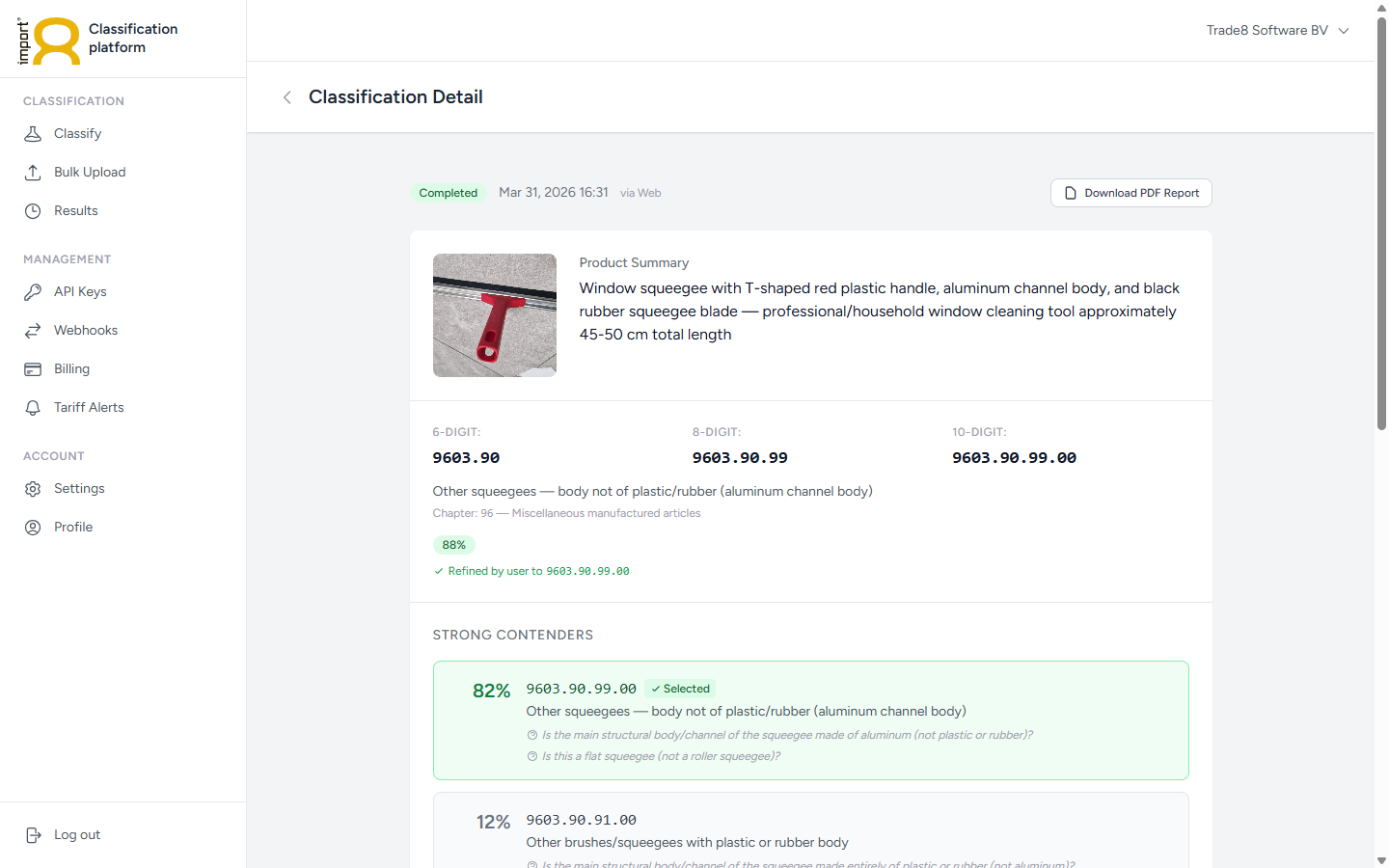
Review results with confidence scores
You receive one or more candidate codes, each with a confidence score and an explanation of why that code was selected. This lets you evaluate the classification rather than blindly accepting it. If two codes are close, you can see the reasoning and make an informed decision.
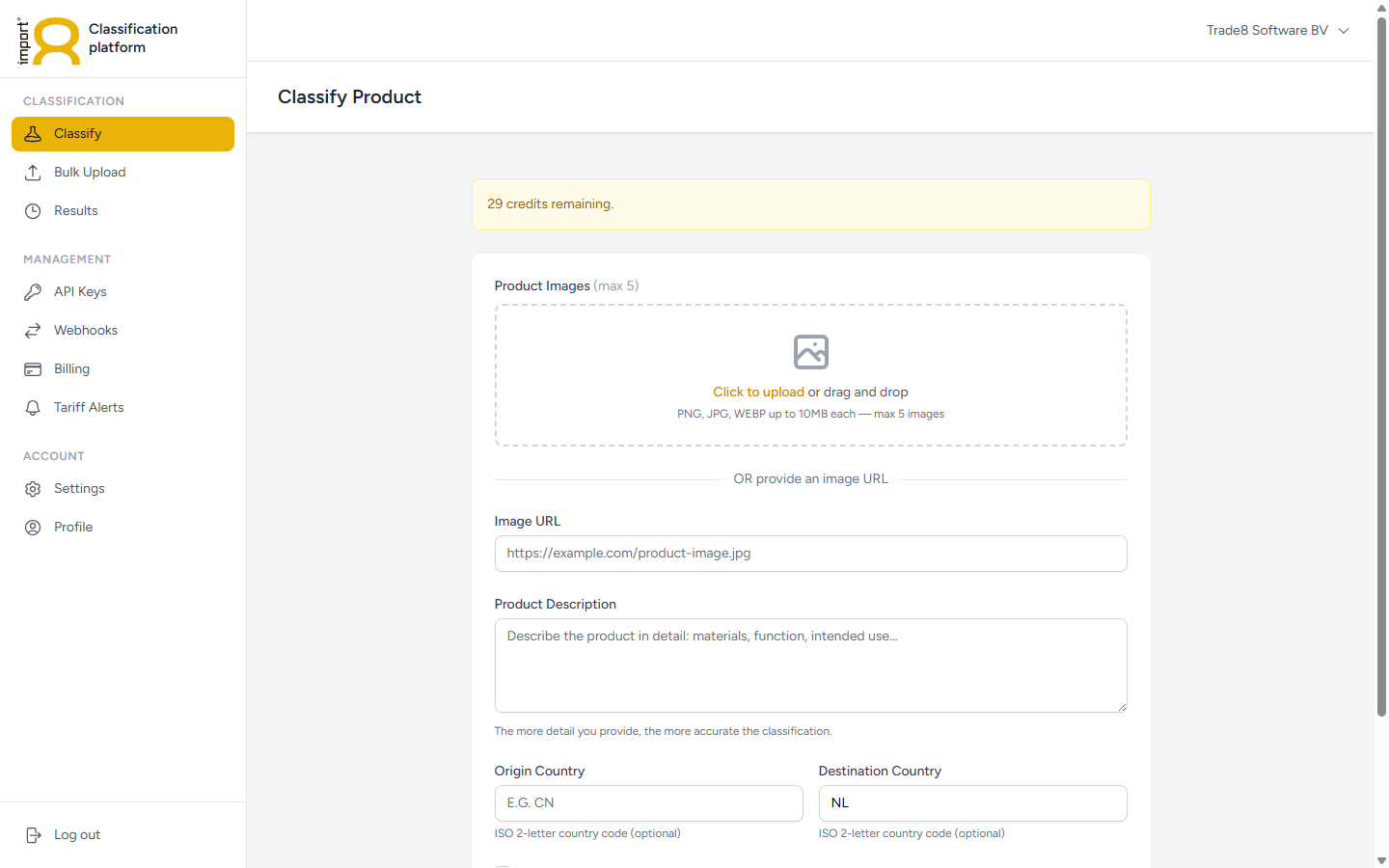
Import8 classifies products against the full EU TARIC database in seconds — with explanations you can audit.
HS Code Structure: A Quick Overview
HS codes follow a hierarchical structure: 2-digit chapters, 4-digit headings, 6-digit subheadings (internationally harmonized), then EU-specific extensions to 8 digits (CN code) and 10 digits (TARIC code). The 10-digit TARIC code is the one you declare on your EU customs entry — it determines your exact duty rate, any anti-dumping measures, and quota eligibility. For a complete breakdown of each level — including examples, GRI rules, and how to read the Explanatory Notes — see our full guide: HS Codes Explained: How EU Customs Classification Works.
Common Classification Challenges
Not every product maps neatly to a single code. Here are the scenarios that trip up even experienced importers.
Multi-material products
A backpack with a nylon body, leather straps, and a metal frame — is it classified by the nylon (Chapter 42), the leather (Chapter 42, different heading), or the metal (Chapter 73)? The answer depends on which material gives the product its "essential character" under GRI Rule 3(b). For this backpack, it is the nylon textile outer that determines the classification.
Sets and assortments
A gift set containing a ceramic mug, a bag of coffee beans, and a wooden spoon. Three different chapters, one package. GRI Rule 3(b) says you classify by the component that gives the set its essential character. If the mug is the main item, the entire set is classified as ceramics (6912). If no single item dominates, GRI Rule 3(c) says use the code that comes last numerically.
Parts vs. accessories
A replacement screen for a laptop is a "part" and generally follows the machine's code (Chapter 84). A laptop sleeve is an "accessory" and has its own code (Chapter 42). The distinction matters because parts often get the same duty rate as the finished product, while accessories are classified independently and may carry a higher or lower rate.
Unfinished and semi-processed goods
GRI Rule 2(a) says that an unfinished product is classified as the finished product if it has the essential character of the finished article. An unassembled bicycle shipped in parts is still classified as a bicycle (8712). But a bicycle frame shipped alone is classified as a bicycle part (8714). The line between "unfinished product" and "part" is where classification disputes often arise.
Technology products that cross categories
A smartwatch tells time (Chapter 91 — watches), takes photos (Chapter 90 — optical instruments), and processes data (Chapter 84 — computers). A fitness tracker without a display might fall under Chapter 90 as a measuring instrument. These multi-function devices are some of the hardest products to classify, and customs authorities across EU member states do not always agree on the answer.
5 Tips for Getting Your HS Code Right
Describe the product by function, not appearance
The HS system classifies products primarily by what they do, not what they look like. A "silicone mat" could be a baking mat (Chapter 39 — plastics), an electrical insulation mat (Chapter 85), or a yoga mat (Chapter 39 or 40). Focus on the product's primary function and intended use when searching for codes.
Always read the Section and Chapter Notes
The legal notes at the beginning of each Section and Chapter define what is included and excluded. They override everything else. Chapter 85 Note 1(a) excludes "electrically warmed blankets" — those go to Chapter 63, even though they contain electrical components. Skipping the notes is the single most common source of classification errors. Avoid the most costly classification mistakes by reading these notes first.
Apply the General Rules of Interpretation (GRI)
The six GRI rules are the legal framework for classification. Rule 1 says: start with the heading text and the Section/Chapter Notes. Rule 3 handles products that could fall under multiple headings. Rule 6 says subheadings within the same heading follow the same logic. Learn these rules — they are the foundation of every classification decision. The WCO publishes them in full.
Check BTI rulings for similar products
The EU publishes all Binding Tariff Information rulings in the EBTI database. Search for products similar to yours and see how customs classified them. While another company's BTI is not binding for you, it shows how customs authorities interpret the nomenclature in practice. This is especially useful for borderline cases.
When in doubt, get a BTI or consult a broker
If the classification is genuinely ambiguous and the financial stakes are high, apply for a BTI ruling or consult a licensed customs broker. The cost of professional advice is almost always less than the cost of a wrong classification discovered during an audit. For a quick sanity check on your classification, you can also use Import8's free HS Code Sanity Check.
Not sure if your code is correct?
Our free Sanity Check compares your code against AI classification and flags mismatches.
Frequently Asked Questions
Not entirely. The first six digits of the HS code are internationally harmonized across all WCO member countries. However, each country or trade bloc adds its own extensions beyond those six digits. The EU uses 8-digit CN codes and 10-digit TARIC codes. The US uses 10-digit HTS codes. These extensions are different, so a product with the same 6-digit HS code will have a different full code (and potentially a different duty rate) in the EU versus the US. Always check the local nomenclature for the country you are importing into.
This is where the General Rules of Interpretation (GRI) come in. GRI Rule 3(a) says the most specific description wins. If two headings are equally specific, GRI Rule 3(b) says classify by the material or component that gives the product its essential character. If that still does not resolve it, GRI Rule 3(c) says use the heading that comes last in numerical order. Importantly, "last in numerical order" does not always mean the highest duty — it is a tiebreaker, not a penalty. If you are genuinely unsure, a BTI ruling gives you legal certainty.
The WCO revises the Harmonized System every five years. The most recent major revision (HS 2022) took effect on January 1, 2022, and introduced new codes for items like drones, smartphones, and 3D printers. The next revision (HS 2027) is scheduled for January 1, 2027. In the EU, the TARIC database is updated more frequently — duty rates, trade measures, and anti-dumping duties can change at any time through EU regulations. It is good practice to re-verify your codes at least once a year.
No. The TARIC code and duty rate are the same across all 27 EU member states. The EU operates as a single customs territory with a Common External Tariff. Whether you import through Rotterdam, Hamburg, Le Havre, or Piraeus, you use the same 10-digit TARIC code and pay the same duty rate. The only thing that varies by country is the import VAT rate (21% in the Netherlands, 19% in Germany, etc.) and some national excise duties on specific products like alcohol or tobacco.
You can absolutely classify products yourself — there is no legal requirement to use a customs broker for classification. Many importers classify their own goods, especially for straightforward products. However, the legal responsibility for correct classification always rests with the importer of record, regardless of who did the classification. For complex products, multi-material goods, or high-value shipments where the duty difference between two codes is significant, professional advice is worth the investment. AI classification tools like Import8 offer a middle ground: faster than manual lookup, with explanations that help you understand and verify the result.
A Binding Tariff Information (BTI) is a formal decision from a customs authority that tells you the exact classification code for your product. It is legally binding across all EU member states for three years (five years from 2024 onward under the updated Union Customs Code). Applying is free, but the process takes 30 to 120 days and requires you to submit a detailed product description, photos, and sometimes a sample. A BTI makes sense when: (a) the classification is genuinely ambiguous, (b) you import the product repeatedly, and (c) the financial impact of a wrong code is significant. For products where the classification is clear-cut, a BTI is unnecessary overhead.
